I’m sure you’re all seeing reports about the decline of huge consulting firms: salary freezes, layoffs, reductions in recruitment. Particularly for strategy engagements, clients are realizing that consulting fees based on bloated hourly rates lead to profoundly misaligned incentives and lousy outcomes. Meanwhile AI is reducing the need for the entire middle tier inside strategy consultancies.
I’m seeing early indications of promising new directions for strategic advisory services. First, firms like 808MPH, LLC hire actual entrepreneurs and execs, rather than bright but inexperienced MBAs. Next, hot new strategy firms create an optimum combination of white-glove services and AI solutions (have a look at the offer from https://ascendancy.co/). And finally, I love seeing companies get past the babyish time-and-materials business model. Watch for firms with the confidence and guts to offer performance-based compensation such as Creative Dock Group.
My pal Shar Broumand likes to remind people that the entire consulting system was built on the assumption that time = value, and for many endeavors AI is bringing the cost of incremental cost of effort to zero. This is an AI-driven change of paradigm that is so profound that it’s hard to think through its implications, but I know they are staggering from my experience in similar paradigm shifts. 20 years ago SaaS changed business math forever by hugely reducing the incremental cost of production to nearly zero, and by enabling seamless international expansion through the cloud. Now, AI is changing the math by making the incremental cost of ‘effort’ minimal for many activities. What in the hell does this mean?
An energetic conversation with Brennan Pothetes challenged me to gather my thoughts around spectacular failures (and huge successes) of leaders I have worked alongside over the last three decades. Have a listen and please weigh in with your insights on the attitudes and behaviors of successful (and unsuccessful) leaders.
Thanks to DisruptHR for giving me five minutes to berate a senior team of HR professionals about how Generative AI will change everything. Have a look here and get back to me.
Argue. Criticize. Praise. But think about what I’m saying, please, it’s terribly important.
As you watch the chaos swirling around a bank run, have you been triggered? It’s easy to capitulate to gloomy forecasts on the VC industry in general. I want to remind all of you that VC industry is a robust national treasure. Like the entrepreneurs it serves, the VC industry is not fragile to brittle, and will continue to drive long-term macroeconomic growth in the U.S.
Feeling a little rattled today? Take heart. Think about two facts on the long-term health of our venture economy:
1 – Venture capital-backed companies account for 41% of total US market capitalization and 62% of US public companies’ R&D spending.
2 – Among public companies founded within the last fifty years, VC-backed companies account for half in number, three quarters by value, and more than 92% of R&D spending and patent value. Yes, you read correctly, over 90% of R&D spending comes from VC-backed companies.
America’s venture capital industry is one of our country’s greatest economic assets. Looking at total funding and funding per capita, it’s clear that America is the global leader in the industry. While deeply shocking, one bank failure does not indicate systemic weakness or decline. I hope recent events will solidify our resolve to remain at the forefront of the global VC industry.
Thanks to Will Gornall (Sauder School of Business) and Ilya A. Strebulaev (GSB, Stanford) for their research reminding us of the remarkable economic impact of venture capital.
A recent conversation with Daniel Ross gave me a chance to share some of the most important patterns I’ve seen in 35 years of venture-building and innovation in Silicon Valley. Curious about my experience with astronauts, dairy-farm veterinarians, and African entrepreneurs? Have a listen on Daniel’s Substack platform.
You’ve probably found Presentation 101 training isn’t enough when you’re crafting online interactive experiences with partners, colleagues and clients.
We built Mach49 initially to support intense, face-to-face teaming. You all know the basics of effective team activities: clear agenda, define goals, blah blah blah. However as we shift interactions online into focused 1-2 hour sessions, I’ve noted four success principles that weren’t obvious at first…
1 – SELF-DIRECTION
Attendees engage much better if they can choose their areas of focus. Rather than a canned exercise, it’s best to (a) provide multiple topic areas for attendees to select, and (b) allow groups to self-assemble around topic areas.
2 – URGENCY
Looming deadlines are energizing! Exercise teams working remotely need clear (and near) deadlines to deliver output, and must understand exactly what result is expected. A digital timeclock is a big help.
3 – ACCOUNTABILITY
Each team should expect to present their output to the entire group. No one wants to look like an unprepared donkey in front of the full audience, even on a screen.
4 – UPSIDE
Competition is helpful. Teams should understand that they’ll benefit if they provide great output. Figure out a motivating award. Examples are prizes, seed funding, and recognition from senior leadership.
You’ll need these trick to keep your audience engaged in the activities. Remember…ATTENTION IS THE SCARCEST RESOURCE IN 21stCENTURY BUSINESS.
Do you have a fifth principle to add? Something you’ve discovered since your world changed in early March? Let me know.
Most of us are more interested in the business and social implications of exponentially advancing technology, rather than in the wonky details of the actual tech. With everyone braying about tech breakthroughs every day, how can you interpret what you hear? I’ve written about one lens to help you understand emerging technology – see my piece on Three Horizons – and here’s another framework I find useful.
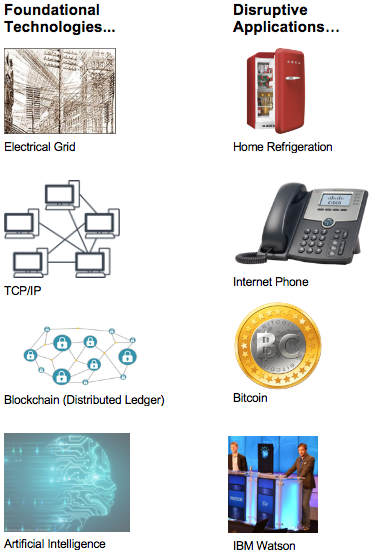
I now realize I spent many years confusing Foundational Technologies with Disruptive Applications. Here’s an example: When NetScape created their first browser in 1994, I remember everyone talking breathlessly about TCP/IP, the fundamental protocol for internet communication. I failed to understand that TCP/IP was a Foundational Technology, poised to change the way we all live and work with a myriad of online experiences, whereas the NetScape Mosaic browser was one among many Disruptive Applications of TCP/IP.
Let’s have a look at some key distinctions:
Foundational Technologies….
Disruptive Applications….
Create new foundations for our economic, political and social systems.
Usually begin in the commercial world, attacking a traditional business model with a lower-cost solution and overtaking incumbent firms quickly.
Appear abstract and theoretical; Require background in science or technology to understand.
Are communicated with a simple and clear business value proposition.
Take decades to seep into our business infrastructure.
Emerge over years, never require decades.
Are adopted steadily and gradually.
Disrupt existing industries with targeted, rapidly-growing ventures
Enable novel, complex systems.
Enable transformative applications.
Here are a few examples:
We can count on government labs and large corporate R&D facilities to continue pumping out the basic research leading to Foundational Technologies. When it comes to Disruptive Applications, though, my money is on (1) startup entrepreneurs, and (2) big-companies intrapreneurs who are given the latitude to create bold new ventures. For example, global giant Schneider Electric recognized the incredible advance of renewable energy as a broad Foundational Technology. We worked with a small, nimble team from Schneider to build eIQ Mobility, a Disruptive Application for charging fleets of electric vehicles.
The next time you hear a breathless description of an emerging technology, try categorize it as a Foundational Technology, a Disruptive Application, or something in between. And, as always, talk to me. I’d like to know if you find this distinction helps you think about the unruly world of technology.
Feeling sorry for yourself after a week of Shelter In Place? No whining, please. The astronauts NASA plans to send to Mars will be sheltering in place for nine months in a cramped metal tube. Let’s see what we can learn from NASA’s plans.
NASA is just beginning to grapple with the emotional impact of long journeys through deep space. Often we can look to science fiction for inspiration, but we’ll get no help in this case. Science fiction writers use two tricks to skate around the thorny issue of long, long journeys through space:
Warp Drive: A convenient plot device for avoiding endless travel time
Hypersleep: The second sci-fi trick to cheat time
You may have heard about the physiological challenges of travel in deep space: Bone demineralization, radiation exposure, eyesight degradation. Barring the invention of a warp coil, astronauts transiting to Mars will face a slew of psychological challenges as well. Cramped, long-duration space travel could lead to fatigue, anxiety, decreased brain functioning….even psychotic breakdown.
How can NASA mission planners address some of the psychological risks of deep-space missions, long before we set out for Mars? For challenges like these, I always recommend finding analogous experiences to help find direction. Let’s see what we can learn from astronauts orbiting Earth on the International Space Station, as well as roughly analogous endeavors such as submarine missions or exploration of the poles.
Meaningful Work
Cultural anthropologist Jack Stuster pored over journals written by astronauts on the International Space Station. What made life difficult for the astronauts? The majority of frustrations came from workflow issues that are probably quite familiar to you: Insufficient time to complete tasks, poorly written instructions, conflicting leadership demands.
Stuster’s recommendations to NASA for maintaining emotional equilibrium during long space voyages will also sound familiar to you. Examples: Allow the astronauts to control their schedules if possible, design tasks to have tangible benefits, and distribute tedious work across all crew members. One interesting tidbit from his research: There’s evidence that the act of journaling was helpful, in and of itself.
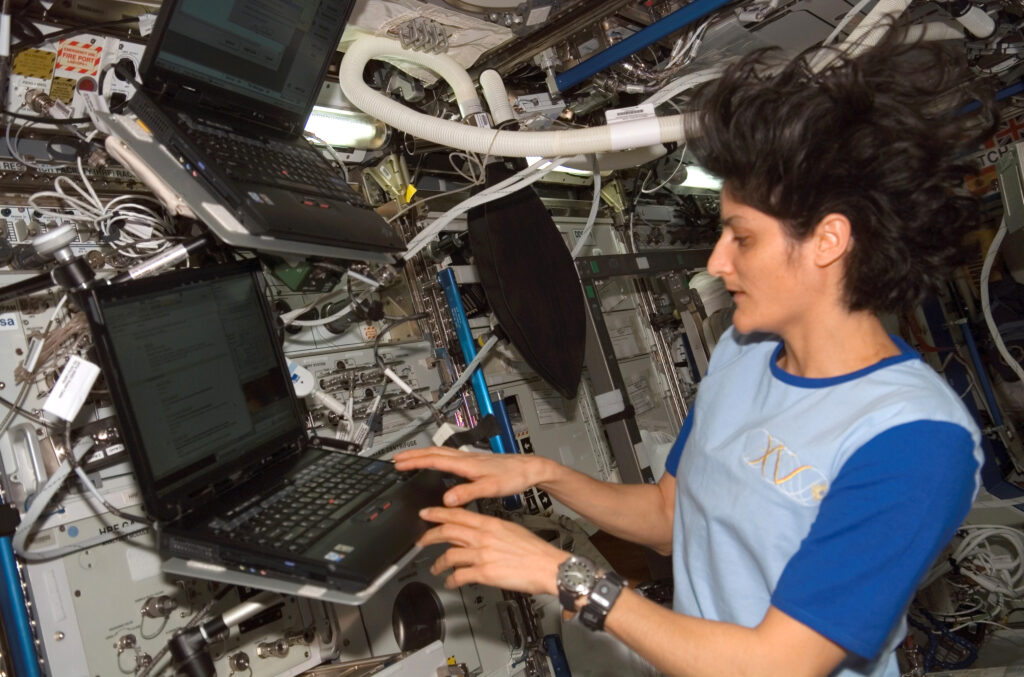
Astronaut Sunita Williams keeping her journal (courtesy NASA)
Effective Leadership
When I asked my good friend Commander Noel Gonzalez to share with NASA his experience while undersea for months as Captain of the Navy submarine USS Cheyenne, he pointed immediately to leadership as key to maintaining morale (and sanity) of his crew. Beyond basic leadership strategies such as clear communication and effective delegation, Noel prides himself on his sensitivity to the intangibles on board his submarine: Mood, energy, tone.
From a very different vantage point, Organizational Psychologist Lacy Schmidt agrees. While studying the team climate at Antarctic Research Stations, she points to quality of leadership as a key influencer of group behavioral health. In particular, Schmidt highlights the importance of interpersonal interactions to influence others’ perceptions. Faced with the desolate environment of Antarctica (and, by extension, Mars) she states that “the objective characteristics of an extreme environment are less important than subjective perceptions of the environment in relation to performance“.
It’s incumbent on any leader to maintain the team’s morale, and it will be essential for future leaders of Mars missions to look after the crew’s emotional well-being en route to the red planet. I hope they’ll take leadership advice from submariners and antarctic explorers. Fostering teamwork and solidarity are critical to reduce conflicts and stress.
Antarctic research stations are a decent analog for Mars
Communications with Earth
In Jack Stuster’s review of astronaut journals, he found that communication with family and friends back on Earth was a welcome relief from the monotony of the space station environment, the lack of social variation, and the limited privacy. No surprise there, but here’s an interesting implication: Social connection, even with a long time delay, will help astronauts combat the third-quarter phenomenon which is consistent across all the missions I’ve mentioned. Whether you’re cooped up in a submarine or wintering over in Antarctica, there is a decline in performance during the third quarter of missions in isolated, confined, and extreme environments, regardless of actual mission duration.
And speaking of maintaining long-distance connections with family and friends…As long as we’re all sheltering in place, think about taking a cue from the astronauts. Set up video cocktail hours and video dance parties with your friends and family. We’re planning our second virtual cocktail party tonight, complete with online games.
VR-Enhanced Training and Entertainment
While underway to Mars, astronauts may leave the ship to enter an artificial environment using virtual reality headsets. You can imagine VR’s contribution to training. Astronauts have time to practice Mars surface operations while on the nine-month journey. Imagine maintaining certain high priority skills, like piloting the Space Exploration Vehicle across the Martian terrain. VR gear could also make it easier for astronauts to learn new skills such as geological investigations, or even how to conduct astronomical observations between Earth and Mars.
And if astronauts are bringing along VR gear for enhanced training, you can bet a holodeck application will be thrown in for some entertainment. Sign me up.
Talk to me….
I hope you’re inspired by NASA’s plans to visit Mars. Humans are built to explore, and Humanity’s aspirations to explore space will drive us toward unprecedented technological innovations that will undoubtedly benefit mankind in one way or another.
Talk to me. Inspiring? Thrilling? Wasteful? Gratuitous? As always, I welcome all comments. We all advance our thinking and ourselves through open-mindedness, humility, and tolerance for other points of view.
The Bookings Institution argues that unbalanced growth in tech has contributed to a terrible political divide in our country that will only get worse.
The authors make a convincing case that the heartland needs growth centers to drive economic inclusion and socioeconomic mobility. Right now the mix is terrible: Top innovation metro areas in the US — Boston, San Francisco, San Jose, Seattle, and San Diego — accounted for more than 90% of the nation’s innovation-sector growth during the years 2005 to 2017.
My perspective: Keep the faith! Leaders like Carter Williams of iSelect Fund in St Louis are already demonstrating big successes in bringing innovation to the heartland.
Have a look at this short article and get back to me with your thoughts….
There’s a lot to like about living in Silicon Valley, working in emerging tech, and engaging with brilliant thinkers at places like Stanford. I’m lucky enough to live the global intellectual nexus of technology and entrepreneurship. But…(and you knew there was a “but” coming) I’m choking on the sheer number of “strategic technology frameworks” getting churned out, and I have a bad feeling that most were created by academics who have never created an innovative product or built a new venture.
There are a few frameworks I do find incredibly useful as I go about my day job, helping “intrapreneurs” create tech-enabled new ventures for big companies. Let me share one, and please weigh in with your favorites. Look for a few more in future posts.
No Borders – Only Horizons
Kudos to Baghai, Coley, and White for publishing their Horizon framework in 2000, in ‘The Alchemy of Growth’. By creating a taxonomy of three horizons, they gave corporate execs a practical way to think about technology and make intelligent decisions about strategy and execution for tech innovation programs. Here are the three horizons that help decision-makers to deliver on tech-enabled challenges:
Horizon 1: Extend Core Technologies, 1-2 years
Companies use existing tech to improve their business models and maximize their value and effectiveness in the short-term.
Big companies love Horizon 1, because they’re structured to deliver on core competencies and embrace incremental change.
Horizon 2: Develop New Opportunities, 2-5 years
Organizations invest in emerging technology to generate substantial value in the future, often around disruptive opportunities.
These programs extend a company’s business model and its core capabilities to entirely new customers, new markets, or both.
Horizon 3: Create Viable Future Visions, 5-10 years
Research programs and academic collaboration lead to the creation of entirely new capabilities and new businesses.
This is the realm of R&D labs in large organizations, and spooky organizations like DARPA.
So, why should you care about this? Because nearly all companies do a crappy job on Horizon 2, and tech-enabled Horizon 2 opportunities are key to your company’s survival. Have you noticed that certain initiatives in your organization, like implementing AI for predictive maintenance or adding IoT to your industrial processes, are always 2-4 years away, year after year? That’s because Horizon 2 programs defy corporate innovation processes and remain stubbornly out of reach for most organizations.
What processes work for successful Horizon 2 programs? I’ve been at this for 30 years and I’ve only seen one successful strategy for Horizon 2 programs: Create autonomous teams of entrepreneurial people, get them the hell out of the office, and lift corporate governance. In short, take a page from disruptive startups. None of these steps is easy, but Mach49 and other incubators area seeing remarkable results. In my career, external incubations are the first consistent path I’ve seen for huge organizations to create disruptive new ventures.
It’s been a pleasure to watch RWE, the massive German energy company, beat the odds and propel Horizon 2 initiatives forward through incubation. The leadership knew they could not keep pace with the market using internal processes, so they selected an entrepreneurially-minded employee, Sukhjinder Singh, to lead internal startup pear.ai. Thanks to Sukhjinder’s boundless energy and drive, Pear is embracing AI-enabled chatbots and natural language processing to extract value from energy data. RWE delivered a Horizon 2 program in record time, and had they employed their internal innovation methods, the new business would have been delivered…never.
Talk to me. Which tech innovation frameworks are helpful for you? I’ll share two more in future posts.
Credits and thank you to Baghai, Coley, and White for publishing their Horizon framework in 2000, in ‘The Alchemy of Growth‘



Leave a Reply